Specialised edition developed with advice and guidance from the
Thomas Pocklington Trust
Compatible with:
JAWS and other screen readers
Dolphin SuperNova and other magnification software/hardware
Google and other captioning software
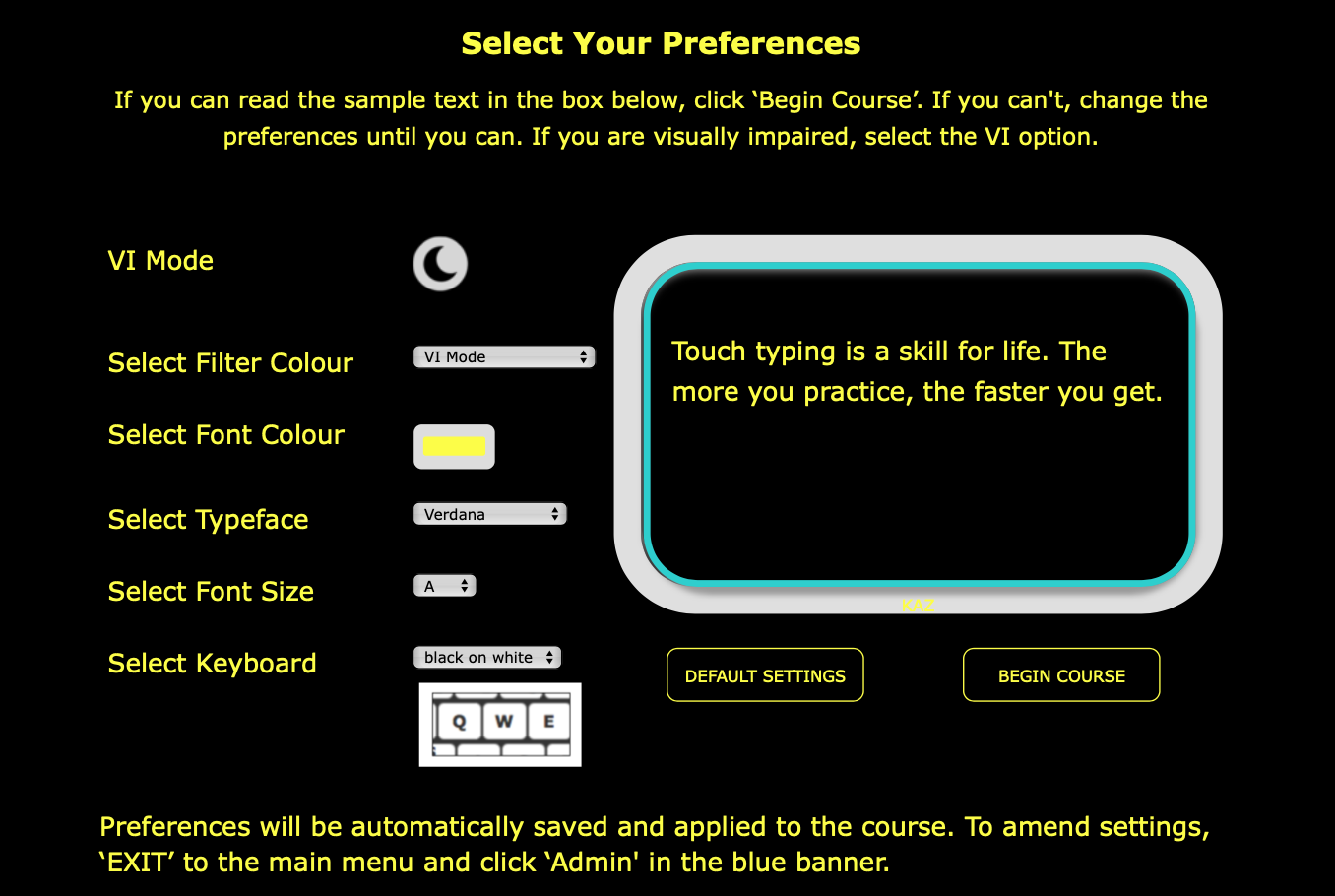
Learning to touch type is considered one of the most beneficial skills for visually impaired and blind individuals. This is because it allows them to transfer their thoughts easily and automatically onto a screen. It provides them with an invaluable tool and asset for independent working and communicating.
Learning to touch type at any age can dramatically boost confidence, self-belief and independence. However, teaching learners with visual impairment at an early age can drastically transform their experience whilst at school and in FE/HE. It puts them on a more even standing with their sighted peers and opens doors to new career opportunities.
Achieving muscle memory and automaticity when touch typing increases efficiency and productivity. However, most importantly, it frees the conscious mind to concentrate on planning, composing, processing and editing, greatly improving the quality of the work produced.
Elias was a digital archivist, a man who spent his days rescuing corrupted data from forgotten hard drives. He had found this specific drive in a bin of "electronic scrap" at a local flea market. The drive itself was battered, smelling of ozone and old dust, but it had yielded only this one file. No metadata, no creation date—just that cryptic alphanumeric string.
The flickering blue light of the monitor was the only thing illuminating Elias’s cluttered apartment. On the screen, a single file icon sat in the center of the desktop: .
He hesitated, his mouse hovering over the icon. Usually, these files were nothing more than corrupted family vacation footage or grainy TV recordings. But something about the file size—exactly 8.15 gigabytes—felt intentional, as if it were a container for something much denser than a simple video. He double-clicked.
The player opened to a black screen. For the first thirty seconds, there was only a low-frequency hum, the kind that vibrates in your chest rather than your ears. Then, the image resolved.
It wasn't a video of a place, but a video of a perspective . The camera seemed to be floating through a dense, iridescent fog. As the "camera" moved, the fog parted to reveal glimpses of a city that defied geometry. Buildings didn't rise from the ground; they folded out of the air like origami made of glass and light.
Ajb08156 Mp4 Apr 2026
Elias was a digital archivist, a man who spent his days rescuing corrupted data from forgotten hard drives. He had found this specific drive in a bin of "electronic scrap" at a local flea market. The drive itself was battered, smelling of ozone and old dust, but it had yielded only this one file. No metadata, no creation date—just that cryptic alphanumeric string.
The flickering blue light of the monitor was the only thing illuminating Elias’s cluttered apartment. On the screen, a single file icon sat in the center of the desktop: .
He hesitated, his mouse hovering over the icon. Usually, these files were nothing more than corrupted family vacation footage or grainy TV recordings. But something about the file size—exactly 8.15 gigabytes—felt intentional, as if it were a container for something much denser than a simple video. He double-clicked.
The player opened to a black screen. For the first thirty seconds, there was only a low-frequency hum, the kind that vibrates in your chest rather than your ears. Then, the image resolved.
It wasn't a video of a place, but a video of a perspective . The camera seemed to be floating through a dense, iridescent fog. As the "camera" moved, the fog parted to reveal glimpses of a city that defied geometry. Buildings didn't rise from the ground; they folded out of the air like origami made of glass and light.