The Convergence of Mysticism and Mineralogy: The Literary Legacy of Isidore Kozminsky

: Tracing specific gems through royal lineages and tragedies.

: Assigning stones to specific zodiac signs and planetary energies.

: The belief that physical objects can influence human emotion and fate.

Furthermore, the enduring popularity of such texts highlights a specific psychological need in the modern reader: the desire for enchantment in an age of pure materialism. While contemporary science provides the "how" of the physical world, authors like Kozminsky attempt to provide the "why." By linking gemstones to planetary alignments and zodiacal signs, these works offer a framework of meaning, suggesting that the universe is an ordered, interconnected whole rather than a series of random occurrences.

The human fascination with the hidden properties of the earth is as old as civilization itself. Among the authors who bridged the gap between ancient folklore and modern curiosity, Isidore Kozminsky remains a seminal figure. His writings, particularly his masterwork on the "magic and science" of stones, represent a unique literary genre that blends geological fact with metaphysical speculation. To study his work is to explore a world where the physical attributes of a diamond or emerald are inextricably linked to the spiritual and historical narratives of humanity.

At the heart of this literary tradition is the belief that nature is not a collection of inert objects, but a vibrant system of energies. Kozminsky’s essays and books do not merely categorize minerals by their chemical composition or Mohs scale hardness. Instead, he treats each stone as a vessel for historical drama and "astral" influence. By documenting the legends of cursed diamonds or the protective reputations of amethysts, he preserves a form of cultural history that academic science often overlooks. His writing serves as a repository for the myths that have driven explorers to cross oceans and kings to wage wars.

However, the legacy of this literature is not without its complexities. In the transition from traditional print to digital downloads, the accessibility of these "skachat" (downloadable) texts has democratized occult knowledge. What was once hidden in rare, dusty volumes is now available to any curious mind. This shift has allowed for a broader appreciation of Kozminsky’s blend of poetry and precision, ensuring that the ancient stories of the earth continue to resonate in the digital age.
Related posts

Eisid: Khaus Skachat Knigu

The Convergence of Mysticism and Mineralogy: The Literary Legacy of Isidore Kozminsky

: Tracing specific gems through royal lineages and tragedies.

: Assigning stones to specific zodiac signs and planetary energies. eisid khaus skachat knigu

: The belief that physical objects can influence human emotion and fate.

Furthermore, the enduring popularity of such texts highlights a specific psychological need in the modern reader: the desire for enchantment in an age of pure materialism. While contemporary science provides the "how" of the physical world, authors like Kozminsky attempt to provide the "why." By linking gemstones to planetary alignments and zodiacal signs, these works offer a framework of meaning, suggesting that the universe is an ordered, interconnected whole rather than a series of random occurrences. The Convergence of Mysticism and Mineralogy: The Literary

The human fascination with the hidden properties of the earth is as old as civilization itself. Among the authors who bridged the gap between ancient folklore and modern curiosity, Isidore Kozminsky remains a seminal figure. His writings, particularly his masterwork on the "magic and science" of stones, represent a unique literary genre that blends geological fact with metaphysical speculation. To study his work is to explore a world where the physical attributes of a diamond or emerald are inextricably linked to the spiritual and historical narratives of humanity.

At the heart of this literary tradition is the belief that nature is not a collection of inert objects, but a vibrant system of energies. Kozminsky’s essays and books do not merely categorize minerals by their chemical composition or Mohs scale hardness. Instead, he treats each stone as a vessel for historical drama and "astral" influence. By documenting the legends of cursed diamonds or the protective reputations of amethysts, he preserves a form of cultural history that academic science often overlooks. His writing serves as a repository for the myths that have driven explorers to cross oceans and kings to wage wars. Among the authors who bridged the gap between

However, the legacy of this literature is not without its complexities. In the transition from traditional print to digital downloads, the accessibility of these "skachat" (downloadable) texts has democratized occult knowledge. What was once hidden in rare, dusty volumes is now available to any curious mind. This shift has allowed for a broader appreciation of Kozminsky’s blend of poetry and precision, ensuring that the ancient stories of the earth continue to resonate in the digital age.
To Serve Man, with Software

To Serve Man, with Software

I didn’t choose to be a programmer. Somehow, it seemed, the computers chose me. For a long time, that was fine, that was enough; that was all I needed. But along the way I never felt that being a programmer was this unambiguously great-for-everyone career field with zero downsides.

By Jeff Atwood ·
Comments
Here’s The Programming Game You Never Asked For

Here’s The Programming Game You Never Asked For

You know what’s universally regarded as un-fun by most programmers? Writing assembly language code. As Steve McConnell said back in 1994: Programmers working with high-level languages achieve better productivity and quality than those working with lower-level languages. Languages such as C++, Java, Smalltalk, and Visual Basic have been credited

By Jeff Atwood ·
Comments
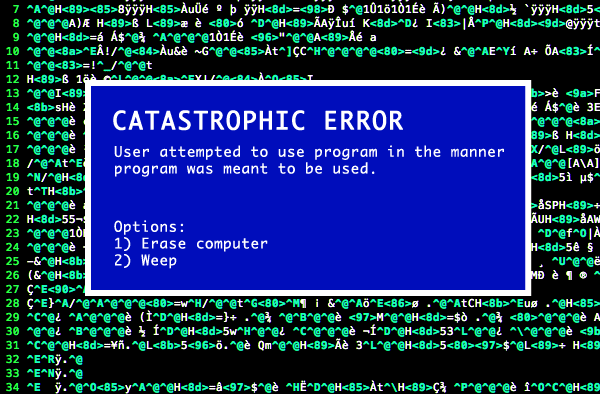
Catastrophic error: User attempted to use program in the manner program was meant to be used. Options 1) Erase computer 2) Weep

Doing Terrible Things To Your Code

In 1992, I thought I was the best programmer in the world. In my defense, I had just graduated from college, this was pre-Internet, and I lived in Boulder, Colorado working in small business jobs where I was lucky to even hear about other programmers much less meet them. I

By Jeff Atwood ·
Comments

Recent Posts

map of the United States via rgmii.org showing all 3,143 counties by rural (gold) / metro (grey) and population

Launching The Rural Guaranteed Minimum Income Initiative

It's been a year since I invited Americans to join us in a pledge to Share the American Dream: 1. Support organizations you feel are effectively helping those most in need across America right now. 2. Within the next five years, also contribute public dedications of time or

By Jeff Atwood ·
Comments
Let's Talk About The American Dream

Let's Talk About The American Dream

A few months ago I wrote about what it means to stay gold — to hold on to the best parts of ourselves, our communities, and the American Dream itself. But staying gold isn’t passive. It takes work. It takes action. It takes hard conversations that ask us to confront

By Jeff Atwood ·
Comments
Stay Gold, America

Stay Gold, America

We are at an unprecedented point in American history, and I'm concerned we may lose sight of the American Dream.

By Jeff Atwood ·
Comments
I’m feeling unlucky... 🎲   See All Posts