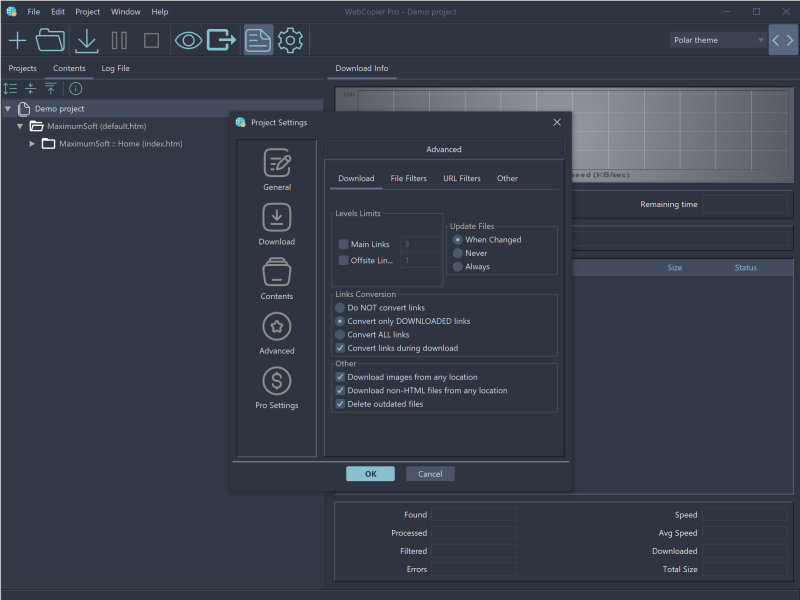
Use this powerful offline browser to download websites
and store them locally, until you are ready to view them.
Download complete copies of your favorite sites, magazines, or stock quotes.
Companies can use WebCopier Pro to transfer company's intranet contents to staff computers / tablets / phones,
create a copy of companies' online catalogs and brochures for sales personal, backup corporate web sites, print downloaded sites.
Developers may use this tool to analyze websites structure, find dead links on a website.
Available on
Windows PCs and
Macs.
Download >
Buy >
This measures your ability to understand, analyze, and interpret written information. It goes beyond vocabulary, testing how well you can identify logical relationships between words or extract themes from complex texts. High verbal scores often correlate with success in fields like law, journalism, and social sciences.
This assesses how comfortably you handle data, sequences, and mathematical logic. Rather than testing pure math knowledge (like calculus), it focuses on your ability to spot patterns in graphs or solve word problems efficiently. This is a critical predictor for success in engineering, finance, and data analysis. IQ vs. Aptitude: What’s the Difference? IQ and Aptitude Tests: Assess Your Verbal, Nume...
The Pillars of Potential: Understanding IQ and Aptitude Tests This measures your ability to understand, analyze, and
Intelligence Quotient (IQ) and aptitude tests are the two most common tools used to measure human cognitive potential. While often used interchangeably, they serve distinct purposes: IQ tests measure general intellectual ability, while aptitude tests evaluate specific skills like verbal reasoning and numerical proficiency. Together, they provide a blueprint of how an individual processes information and where their natural strengths lie. The Core Components: Verbal and Numerical Reasoning This assesses how comfortably you handle data, sequences,
In contrast, are specialized. They are often used by employers or educators to see if a person has the "knack" for a specific role. For example, a candidate might have an average IQ but an extraordinary aptitude for spatial visualization (useful for architects) or mechanical reasoning (useful for engineers). Why We Use Them
This measures your ability to understand, analyze, and interpret written information. It goes beyond vocabulary, testing how well you can identify logical relationships between words or extract themes from complex texts. High verbal scores often correlate with success in fields like law, journalism, and social sciences.
This assesses how comfortably you handle data, sequences, and mathematical logic. Rather than testing pure math knowledge (like calculus), it focuses on your ability to spot patterns in graphs or solve word problems efficiently. This is a critical predictor for success in engineering, finance, and data analysis. IQ vs. Aptitude: What’s the Difference?
The Pillars of Potential: Understanding IQ and Aptitude Tests
Intelligence Quotient (IQ) and aptitude tests are the two most common tools used to measure human cognitive potential. While often used interchangeably, they serve distinct purposes: IQ tests measure general intellectual ability, while aptitude tests evaluate specific skills like verbal reasoning and numerical proficiency. Together, they provide a blueprint of how an individual processes information and where their natural strengths lie. The Core Components: Verbal and Numerical Reasoning
In contrast, are specialized. They are often used by employers or educators to see if a person has the "knack" for a specific role. For example, a candidate might have an average IQ but an extraordinary aptitude for spatial visualization (useful for architects) or mechanical reasoning (useful for engineers). Why We Use Them
Copyright © 1999- MaximumSoft Corp.
All Rights Reserved.