Accessibility

Touch Typing Software for the Visually Impaired & Blind

Point Line Pine - གངས་དཀར་གཡང་འཛོམས། (Tibetan M...

Specialised edition developed with advice and guidance from the Thomas Pocklington Trust

Compatible with:

JAWS and other screen readers

Dolphin SuperNova and other magnification software/hardware

Google and other captioning software

Learning to touch type is considered one of the most beneficial skills for visually impaired and blind individuals. This is because it allows them to transfer their thoughts easily and automatically onto a screen. It provides them with an invaluable tool and asset for independent working and communicating.

Learning to touch type at any age can dramatically boost confidence, self-belief and independence. However, teaching learners with visual impairment at an early age can drastically transform their experience whilst at school and in FE/HE. It puts them on a more even standing with their sighted peers and opens doors to new career opportunities.

Achieving muscle memory and automaticity when touch typing increases efficiency and productivity. However, most importantly, it frees the conscious mind to concentrate on planning, composing, processing and editing, greatly improving the quality of the work produced.
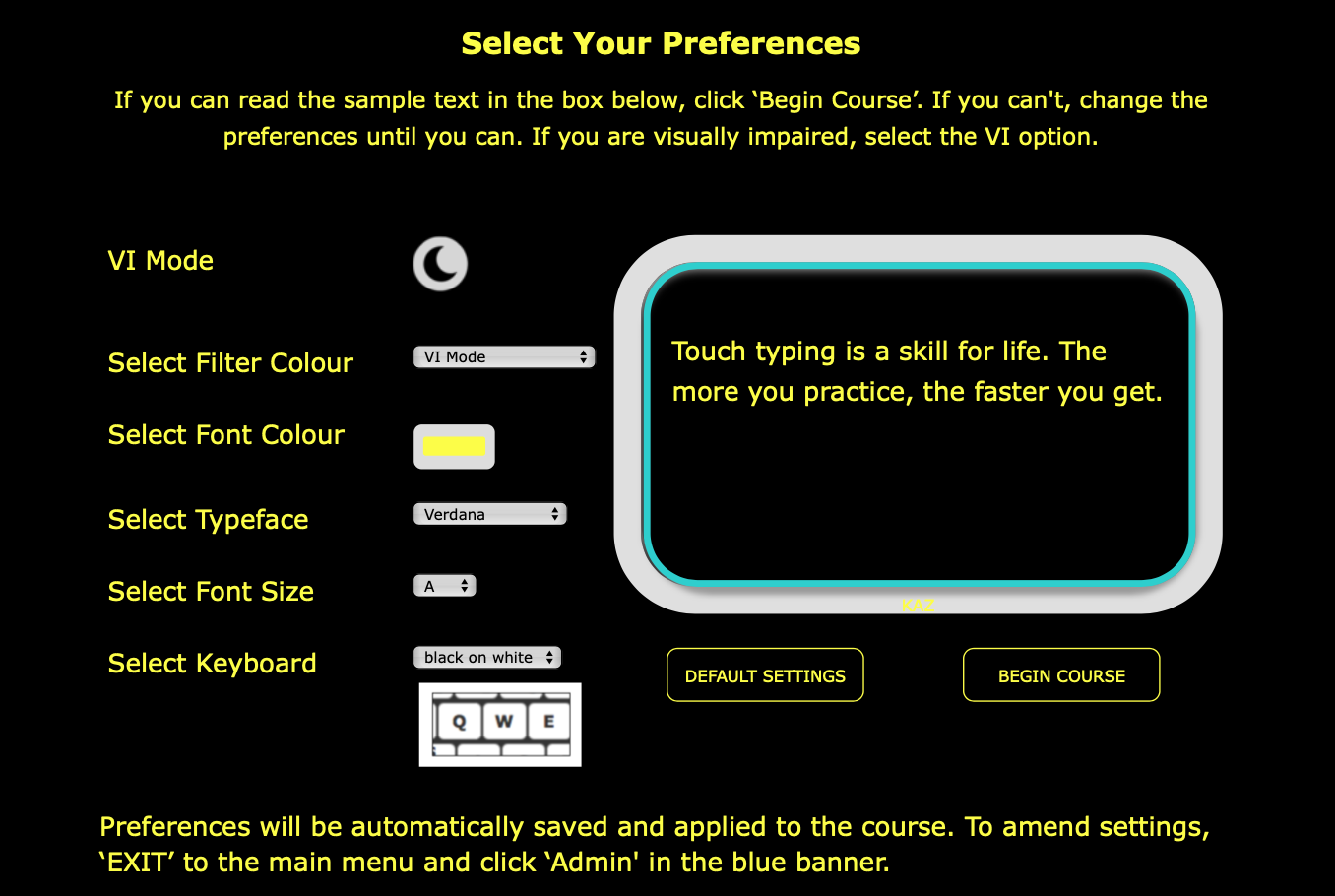
Features of KAZ’s VI/Blind Touch Typing Software:
Point Line Pine - གངས་དཀར་གཡང་འཛོམས། (Tibetan M...

Specialised ‘Preference Screen’ offering a ‘dark mode’ setting and the ability to tailor the course to individuals’ specific needs

Ability to drag/expand the course to the size of your monitor, with no loss of quality

Compatible with screen readers, magnification and captioning software/hardware. However, it is also designed to work stand-alone

KAZ’s proven ‘Accelerated Learning’ teaching method incorporating ‘brain balance’ teaches the skill quickly and easily

Challenge modules cater for users with short term memory and helps develop automaticity and ‘muscle memory’, whilst ingraining spelling

Includes ‘speaking keys’ so learners can hear which key they have typed and spoken instruction with auditory feedback on error keys.

Schools and Business editions include an easy-to-use admin-panel, allowing the upload and monitoring of users in real time. They also allow the upload of problematic/course related vocabulary, allowing users to learn to type and spell simultaneously

The KAZ Course

The KAZ course is a tutorial and is designed to be used independently or with minimum supervision. However, a structured lesson plan is available in Administrators’ admin-panels should they wish to teach the course during lessons.

The course consists of five modules:

Module 1Flying Start - explains how the course works, teaches the home-row keys, correct posture whilst sitting at the keyboard, and explains the meaning, causes, signs, symptoms and preventative measures for Repetitive Strain Injury. The Chinese pine plantations in North China by

Module 2The Basics - teaches the A-Z keys using KAZ’s five scientifically structured and trademarked phrases. The Chinese pine plantations in North China by

Module 3Just Do It - offers additional exercises and challenge modules to help develop ‘muscle memory’, automaticity and help ingrain spelling. The Chinese pine plantations in North China by

Module 4And The Rest - teaches punctuation and the number keys.

Module 5SpeedBuilder - offers daily practice to increase speed and accuracy.

The Chinese pine plantations in North China by evidence from mtDNA

"Point, Line, and Pine" from Men-Tsee-Khang explores the deep structural connections between Tibetan medicine and astro-science, both of which are rooted in the foundation of the five elements. The publication emphasizes the interdependence of these fields, including the importance of astrological timing for medical therapies, as well as the significance of the Chinese Pine in traditional medicine. You can read the full article on the Men-Tsee-Khang website.

Аѕ‚аѕ„аѕ¦ај‹аѕ‘аѕђаѕўај‹аѕ‚аѕўаѕ„ај‹аѕ Аѕ›аѕјаѕ˜аѕ¦ајќ (tibetan M... | Point Line Pine -

The Chinese pine plantations in North China by evidence from mtDNA

"Point, Line, and Pine" from Men-Tsee-Khang explores the deep structural connections between Tibetan medicine and astro-science, both of which are rooted in the foundation of the five elements. The publication emphasizes the interdependence of these fields, including the importance of astrological timing for medical therapies, as well as the significance of the Chinese Pine in traditional medicine. You can read the full article on the Men-Tsee-Khang website.

Copyright KAZ Type Limited 2025. KAZ is a registered trade mark of KAZ Type Limited.

Developed by : STERNIC Pvt. Ltd.